

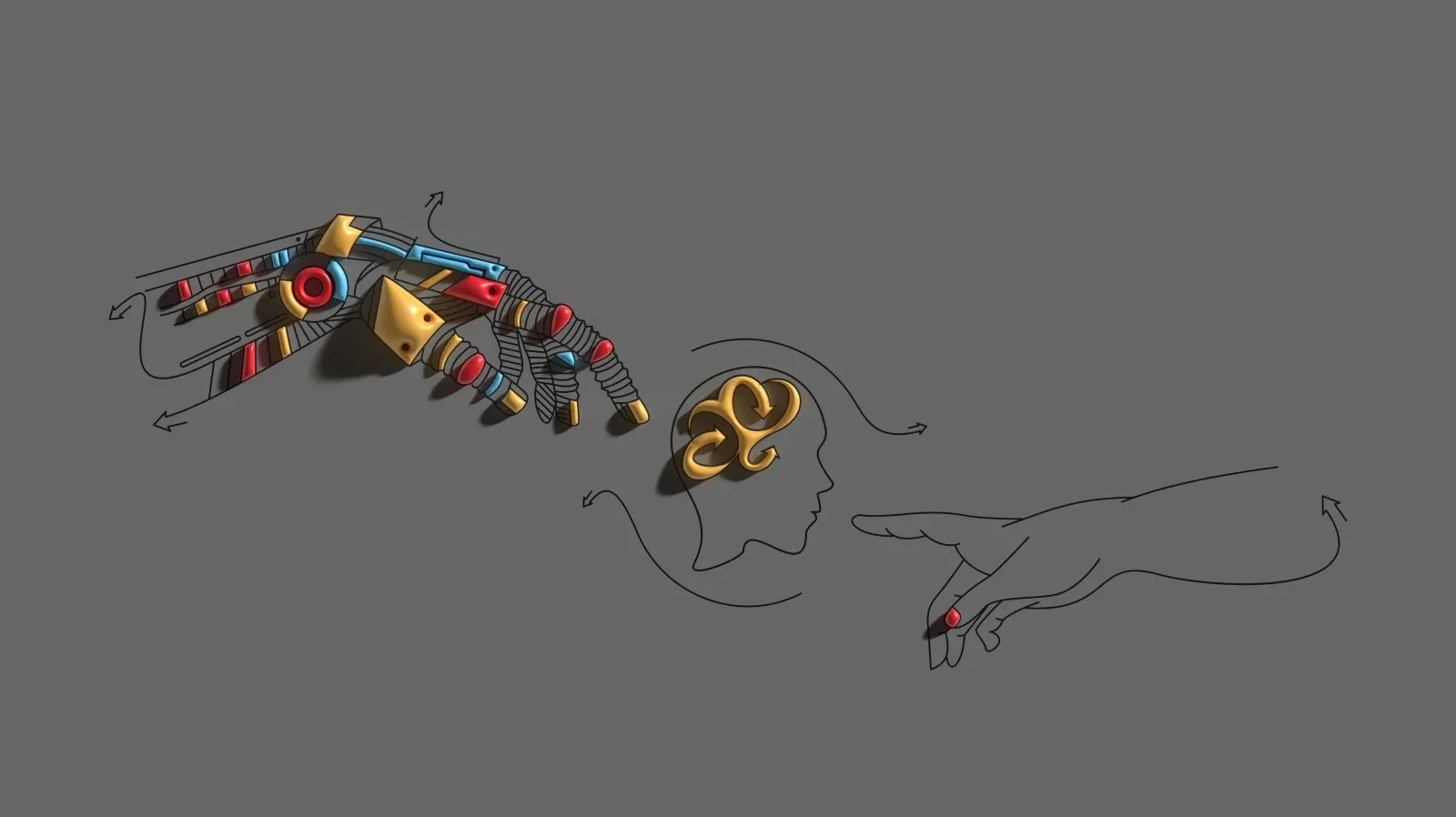
The internet is actively eating its own flesh.
You type a query into a search bar, and first ten results are a horrifyingly perfect mirror of each other. The grammar is fawless.
The structure is impeccable. The soul is entirely missing. We are drowning in a smooth, frictionless soup of words that say absolutely nothing. They take no risks, they have no sharp edges. This isn't just a subjective decline in quality; it is a mathematical catastrophe know as synthetic poisoning. The algorithms are feasting on their own vomit, and the result is a digital pandemic.
Statistical Decay and the Eradication of Tail Data: What Nature Proves
Recently, a massive study published in Nature dragged the Silicon Valley nightmare out of shadows and slapped it onto a spreadsheet: Model Collapse.
Let's look at the cold mechanics. Large Language Models (LLMs) were originally traided on the chaotic, sprawling mess of human history.
They scraped our blogs, our furious midnight Reddit rants, our weird niche forums post. That data was rich, deeply unpredictable, and alive. But today, the internet is flooded with synthetic text.
What happens when the next generation of models trains on the sterile, automated output of the previous generation?
Researchers call it static decay Language is defined not by its averages, but by its anomalies ehat statisticians call tail data.
Human thought is inherently jagged. A frustrated mechanic writes, "The motherboard was fired, the smell of burnt solder is permanently etched into my brain."
An AI absorbs this, sands of the rough edges, and spits out: "The motherboard sustained damage and emitted an unwanted odor." Safe. Sterile. Dead.
When a model ingests that synthetic output for its next training cycle, the unwanted odor disappears entirely.
By the third generation, you are left with Hardware failure detected. The variance collapses. The vibrant edges of human expression are shaved down to a grey, tasteless nub.
Machines forget the rich nuances of language that humanity took tens of thousands of years tı build. The algorithms are starving for fresh human intelligence. Imagine a machine locked in an unventilated room, slowly asphyxiating on its own. That is the exact state of the web right now.
Harvard Law and the Implosion of Intellectual Property
This crisis is tearing through engineering departments, but it is causing absolute chaos in the legal corridors. The traditional doctrine of Fair Use has been completely shattered by algorithmic scraping, and the Us Copyright Office is currently buried under tens of thousand of disputes.
Imagine a concrete scenario straight out of the Harvard Law reviews. A massive marketing agency decides to aggressively cut costs.
They use an AI tool that has learned from 10,000 copyrighted books to generate a 50 page, perfect looking industry guide in seconds.The next day, a competitor deploys a web scraper, rips that exact guide, feeds it into their own LLM, and publishes a "new" version.
Who owns this derivative of a derivative?
Then ten thousand original, unnamed authors?
The intern who typed the prompt?
The software company that coded the scraping bot?
The law draws a brutal line ins the sand: if there is no human authorship, there is no copyright.
The synthetic assembly line is tuning the digital world into a vast, unownable junkyard. Corporations are spending millions of dollars to build massive content empires, only to realize they hold the legal rights to absolutely nothing.
Investors are quietly backing away from Aı content farms. You cannot build a billion-dollar valuation on intellectual property you do not own. Where there is no human touch, there is no ownership. And where there is no ownership, there is no value.
Case Study: The Crash of the AI Slop Empire
Let's ground this in harsh reality. Consider "TrendChaser Media" (a fictional name for a reality that plays out every single day). The founders hooked up pipeline of Apis and started blasting 2,000 SEO-optimized articles a day onto the web.
For three months, the metrics went parabolic. The search engines indexed the flood, traffic skyrocketed, and ad revenue poured in. They genuinely thought they had broken the system.
Then Google dropped the Helpful Content Update like a sledgehammer. The search giant deployed new, ruthless filters designed specifically to detect this synthetic slurry the "AI Slop."
With 48 hours, TrendChaser's traffic chart looked like the pulse monitor of man jumping of a cliff. The bounce rates were hitting 98% because users weren't reading: they were scanning, feeling the artificial coldness and fleeing.
Google wasn't being unfair: Google was trying to save its own business model. Is uses only find robot-to-robot spam when they search, they will abandon the search engine entirely.
Meanwhile, a competitor named "BoutiqueCraft" was publishing just five articles a month. But they where using TheQuill.
Their articles were long, gritty, and reeked of actual human experience. More importantly, they carried cryptographic proof of their human origin.
While TrendChaser burned to the ground, BoutiqueCraft's organic traffic quadrupled. Google didn't just prefer their content; Google need it to survive. Seeking out verifiable human craft is no longer an algorithmic preference; it is an existential imperative.
The Anatomy of TheQuill's "Proof Of Craft"
So show do you actually prove a human wrote it? We all know standard AI detectors are a joke. Swap three adjectives, restructure a sentence, and you bypass them completely.
 TheQuill rewrites the rules of the game by refusing to look at the final text. We do not analyze he dead corpse of the article we record the heartbeat of this creation.
Proof of Craft is a telemetry and sealing engine that captures the microscopic chaos of human creation. Ehen a writer sits at the keyboard, TheQuill's infrastructure goes to work:
Keystroke Rhythm and Doubt Analysis : AI generates text in massive, instantaneous block of tokens. The human brain hesitates. A writer pauses, hammers out of furious paragraph, deletes half of it, doubts their phrasing, and starts over. This asymmetric, deeply flawed rhythm is a biological fingerprint that no algorithm can fake. We capture the hesitation. We record the pain of the backspace key.

Cursor and Navigational Telemetry: We track how the creator navigates the document, the micro-pauses for research on another tab, the erratic scrolling to check previous paragraphs.
Cryptographic Data Sealing : Once the piece is finished, this entire timeline of creation the millions of microscopic data points, the deletions, the swear is compressed into a cryptographic hash. It is permanently sealed into an immutable, verifiable ledger.
The results absolute. You are not just handing an algorithm a piece of text. You are delivering the mathematical, indisputable poof of human labor.
Ehen a competitor points a finder and claims your works is synthetic, you don't argue. You drop and encrypted file on the table that proves the exact birth sequence of every single word.
the human brain has evolved over millennia to seek out the imperfections of another human mind. Ehen we read AI generated text, we feel a distinct 'uncanny valley' sensation.
The word are right, but the ghost is missing. Our brains detect this simulation in milliseconds. The telemetry data provided by TheQuill isn't just signal for google: it is the ultimate bridge of trust between you and audience.
The AI apocalypse is not a sci-fi war against machines: it is a battle against aggressive mediocrity. In a future where algorithms choke on their own hallucinations, human intelligence is no longer a commodity.
Its is a luxury assts. The internet will belong exclusively to those who can mathematically prove they are real.